Mini Challenge - Pixels to Paper
- Kiara Castillo Magallanes
- Oct 23, 2024
- 4 min read

Updated: Dec 13, 2024
Clock Tower
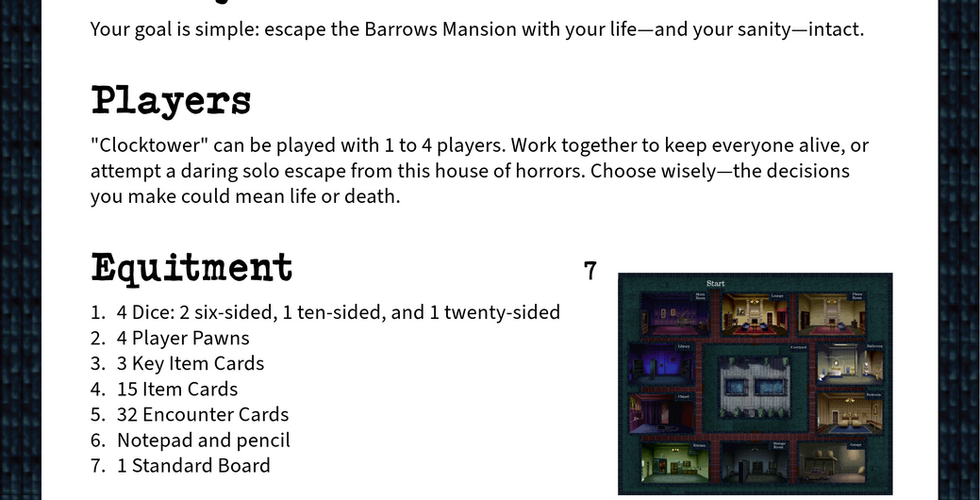
For this project, we drew inspiration from Clock Tower (1995), a classic survival horror video game, and adapted it into an immersive tabletop experience. The board game recreated the tense and suspenseful atmosphere of the original game, incorporating mechanics like strategic movement, hidden objectives, and collaborative survival. Our team developed unique components, including a modular board, and cards, all designed to reflect the unpredictable nature of the original. The process involved translating the emotional beats and mechanics of a digital game into a physical format, ensuring that the essence of suspense and strategy remained intact. Through multiple playtesting sessions, we refined the gameplay to strike a balance between challenge and fun, making it accessible to both fans of the original game and new players. This project tested our ability to adapt a beloved classic into a new medium, deepening our understanding of game narrative and mechanics.
Paper:
Overall Experience of the Game
After discussing and brainstorming ideas on converting the digital game into a physical
format, we decided to stay as close as possible to the original mechanics to provide a similar
experience. The mechanics we chose to preserve include exploring the Barrows mansion in
search of various items to escape, avoiding attacks, and unlocking doors to new rooms, just as
in the original game. To maintain this mechanism of searching, escaping, and unlocking, we
implemented a card system divided into item cards, encounter cards, and key cards. This
approach allowed us to recreate the excitement and strategy that players experience in the
digital game while ensuring a smooth and enjoyable transition to the physical format.

Analysis of the Rules
I believe we did a good job in trying to keep the game as similar as possible to the original,
although this is just my perspective. I think it’s important to gather feedback from others who
play the game. To convert the digital parameters into physical ones, we based our design on
other board games with mechanics similar to those of the digital game, with Clue being one
of our main references. This approach allowed us to adapt the gameplay mechanics
effectively and find solutions for the challenges we encountered during the conversion.
However, it’s essential to continue receiving feedback from players to ensure that our
interpretation is well-received and meets expectations.
Design Process
Regarding the design of the game, the distribution of responsibilities was equitable and
comfortable, leveraging each team member's strengths. These responsibilities were divided
into design/prototyping and mechanics development. My role focused on the design and
prototyping of the game; I researched and gathered resources to obtain the art from the
original game. Additionally, I designed a board game using the elements at my disposal,
creating a physical prototype and developing each of the cards and new elements to achieve a
result similar to the original artwork.
The playtesting process was crucial for the game's development, as it allowed us to identify
errors and inconsistencies in our rules and mechanics. For instance, we made changes to the
encounter cards, particularly the one for Mary Barrows, because the prison system
continuously disrupted gameplay. Through these tests, we gained valuable insights that
helped us refine details and enhance the player's experience.
Game Narrative
When it comes to the game's narrative, we made a conscious effort to keep it as close as
possible to that of the original game. We aimed to respect the escape methods and card
limitations as presented in the digital version. We made some adjustments, such as reducing
the number of rooms, since the original game featured approximately 20 rooms, 2 floors, and
a cave. We decided to retain the 10 main rooms and adjust the escape route, making it more
manageable for players within a reasonable timeframe. This simplification not only facilitates
gameplay but also allows players to focus on the story and atmosphere of the game.
Art
The game Clocktower generally has a dark and desolate aesthetic that evokes feelings of
terror and suspense. Finding resources for the game was relatively easy, which helped us
capture the same vibe as the original game. I was responsible for creating all the art and
visual elements, and I worked hard to maintain the same dark vibes in the color palette we
used. Having access to much of the original artwork made the process much smoother.
However, we also integrated new elements into the game, such as specific items that
appeared on the cards. To create these elements, I converted all the images we used to pixel
format and then edited them in Photoshop to achieve a worn aesthetic that maintained tonal
consistency with the other visual elements.
In summary, our experience in creating a physical version of Clocktower has been both
rewarding and challenging. As we continue to refine our mechanics and narrative, we hope
that players enjoy the unique atmosphere and gameplay we have successfully replicated in this new format. The combination of careful design, thorough testing, and attention to
aesthetics has allowed us to bring this beloved game to life in a new dimension.
Rulebook:




Play Time:
Art Design:
Cards:
Board:

Team credits:
Jules Pages
Jason Ferguson
Thomson Marquis
Kiara Castillo Magallanes


Comments